
Gold Price During War: Why Prices Drop First Then Rise (2026)

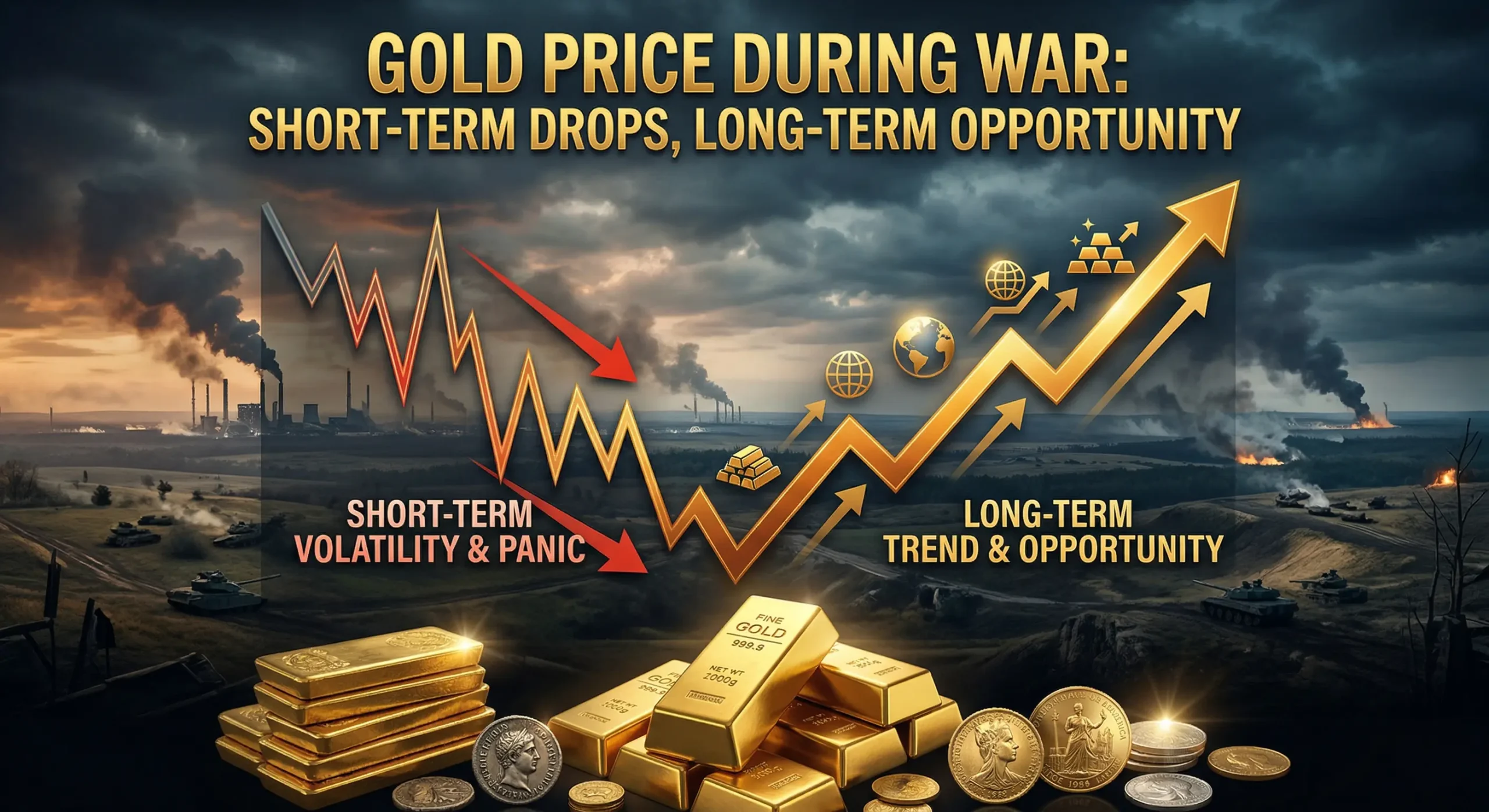
Gold Prices During War: Short-Term Drops, Long-Term Opportunity
The gold price during war does not always move in a straight line.
While many investors expect gold to rise immediately during geopolitical conflict,
the reality is more complex. In many cases, the gold price during war may first decline
before entering a long-term upward trend.
Many investors expect gold to rise immediately during war. However, the reality is more complex.
In some cases, gold prices may experience short-term drops before moving higher over time.
Why Gold Prices Can Drop During War
While gold is considered a safe-haven asset, short-term price movements can be influenced
by liquidity needs and market reactions.
- Investors selling assets to cover losses in other markets
- Temporary strengthening of the US dollar
- Short-term market panic and volatility
- Institutional rebalancing of portfolios
These factors can create temporary downward pressure on gold prices, even during periods of conflict.
The Role of Central Banks
Central banks play an important role in the gold market. While some may adjust their reserves
depending on economic conditions, the long-term trend has generally been toward increasing gold holdings.
Gold remains a strategic asset for national reserves, especially during times of global uncertainty.
War and Long-Term Gold Trends
Historically, gold tends to perform well over the long term during geopolitical instability.
While short-term movements can be unpredictable, the broader trend often reflects increased demand for safety.
This is why experienced investors pay attention to the bigger picture rather than reacting to
temporary price fluctuations.
Why Smart Investors See Opportunity
Short-term price drops during uncertain times can create buying opportunities.
Investors who understand market cycles often use these moments to accumulate gold at lower prices.
Instead of reacting emotionally, they focus on long-term value and wealth preservation.
Key Strategies
- Buy during market weakness
- Focus on long-term value
- Diversify assets across gold and other investments
Gold vs Market Uncertainty
In times of war, uncertainty increases across all markets. Stocks, currencies, and even cryptocurrencies
can become highly volatile.
Gold, however, continues to play a stabilizing role in investment portfolios.
This makes it a critical asset during uncertain periods.
You can explore historical market behavior on
Investopedia
.
Take Advantage of Gold Market Opportunities
Secure your wealth during uncertain times.
Short-Term Volatility vs Long-Term Trend
One important factor to understand is the difference between short-term volatility and long-term direction.
The gold price during war can move unpredictably in the early stages of conflict due to panic,
liquidity needs, and rapid market reactions.
However, as uncertainty continues, investors begin shifting toward safer assets.
This is where the gold price during war often starts to stabilize and gradually move higher.
For long-term investors, these early fluctuations are not a warning sign — they are part of the cycle.
Understanding this behavior helps investors make better decisions instead of reacting emotionally to short-term market moves.
Final Thoughts
The relationship between war and gold prices is not always straightforward.
Short-term fluctuations can occur, but the long-term trend often favors gold as a store of value.
For investors, the key is to stay informed, think long-term, and recognize opportunities
when markets are uncertain.
Historical Patterns of Gold Price During War
Looking at history, the gold price during war often follows a similar pattern.
At the beginning of a conflict, markets react with uncertainty, which can lead to temporary
sell-offs in gold as investors seek liquidity.
However, as the situation develops, demand for safe-haven assets increases.
This is when the gold price during war typically begins to rise, sometimes significantly.
Investors who understand this pattern do not panic during short-term declines.
Instead, they see these moments as opportunities to enter the market at better prices.
Why This Pattern Repeats
- Initial market shock creates liquidity pressure
- Investors rebalance portfolios
- Demand for stability increases over time
- Gold regains strength as uncertainty continues
This is why experienced investors closely monitor the gold price during war
instead of reacting emotionally to short-term movements.